
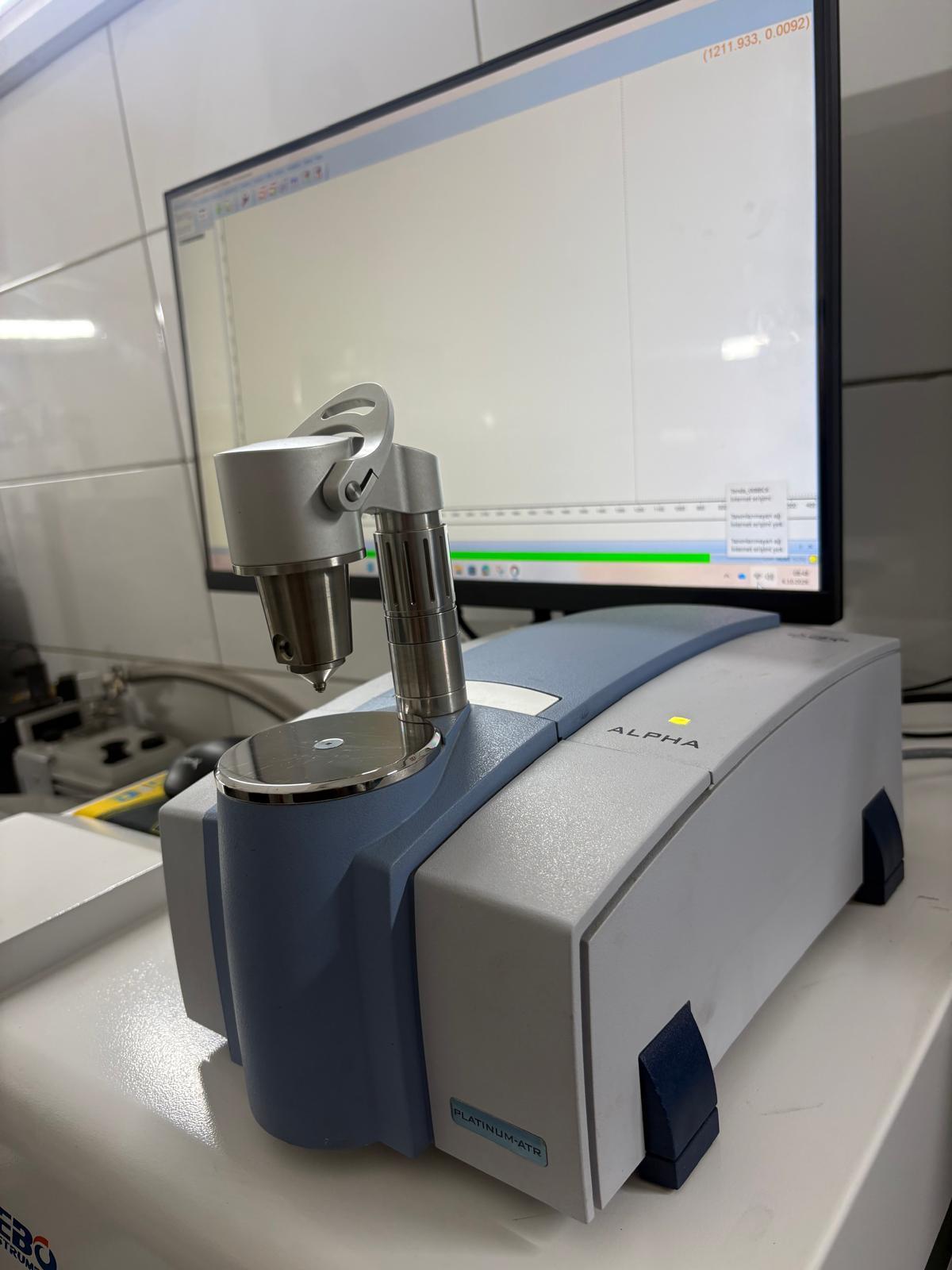
FTIR shows the absorption bands characteristic of carbonate, silicate, sulphate and hydroxide groups in mineral crystal structures. This identifies which minerals are present in ores, rocks and industrial mineral raw materials (calcite, dolomite, quartz, feldspar, kaolinite, talc, gypsum, barite etc.). Analysis is performed on an FTIR (Fourier transform infrared) spectrometer using the ATR (attenuated total reflection) technique; solid, liquid, paste and film samples are usually measured without preparation. The spectrum is compared with reference libraries to identify the material.
FTIR identifies mineral types; it does not give the metal percentage or element content of an ore. Element composition requires chemical analysis methods.
Identified
- Carbonate minerals: calcite, dolomite, magnesite
- Silicate and clay minerals: quartz, feldspar, kaolinite, montmorillonite, talc, mica
- Sulphates and others: gypsum, barite; hydroxide minerals
- Comparison with a reference raw material
Reference Standard
- ASTM E1252 – General techniques for obtaining infrared spectra for qualitative analysis
Samples
Samples should be sent as powder or ground material, a few grams; coarse pieces are ground in our laboratory.