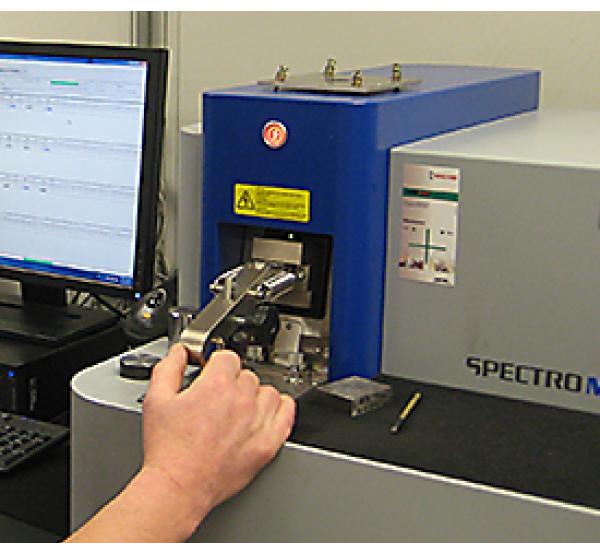
Stainless steel chemical analysis verifies that the material matches the declared grade (e.g. 304, 304L, 316, 316L); carbon, chromium, nickel and molybdenum contents in particular determine corrosion resistance and welding behaviour. Analysis is performed with a spark optical emission spectrometer (spark OES): a spark on the specimen surface excites the elements so that each emits light at its own wavelength, and element contents are determined in percent from the light intensity.
The test is performed with a method accredited by TÜRKAK under TS EN ISO/IEC 17025 (ASTM E1086); results are issued as an accredited test report.
Elements Determined
- Cr, Ni, Mo, Mn, Si, Cu, C, P, S
- Grade identification and comparison with the relevant standard (e.g. EN 10088, ASTM A240)
Applied Standard
- ASTM E1086 – Analysis of austenitic stainless steel by spark atomic emission spectrometry
Specimens and Reporting
The specimen needs a flat surface of at least 15 mm diameter for analysis; the surface is cut and ground in our laboratory. Several sparks are taken on each specimen and the mean is reported; on request, results are compared with the limits of the relevant material standard.