
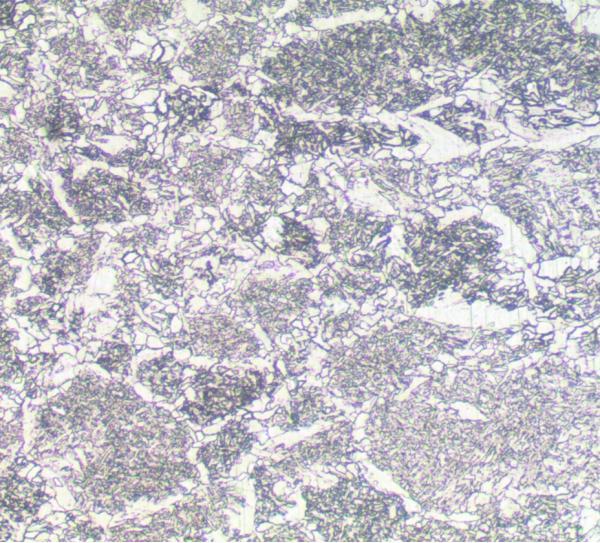
If austenitic stainless steels stay in a certain temperature range during welding or heat treatment, chromium carbides precipitate at the grain boundaries; the adjacent zones become depleted in chromium and susceptible (sensitized) to intergranular corrosion. This is one of the main causes of early corrosion failures in welded stainless steel equipment.
In ASTM A262 Practice A, the polished specimen is electrolytically etched in oxalic acid and the grain boundary structure is examined under the microscope. The structure is classified as step, dual or ditch. Step and dual structures indicate no susceptibility; if a ditch structure is found, the material must be evaluated with the other A262 practices.
Assessed Features
- Classification of grain boundary structure: step, dual, ditch
- Separate examination of weld metal, HAZ and base metal
- Scaled micrographs
Applied Standard
- ASTM A262 – Standard practices for detecting susceptibility to intergranular attack in austenitic stainless steels (Practice A: oxalic acid etch test)
Specimens and Reporting
The specimen is cut, mounted, ground, polished and, where needed, etched with a suitable reagent in our laboratory (ASTM E3). Examination is done with a metallurgical microscope and image analysis software; results are reported with scaled micrographs.